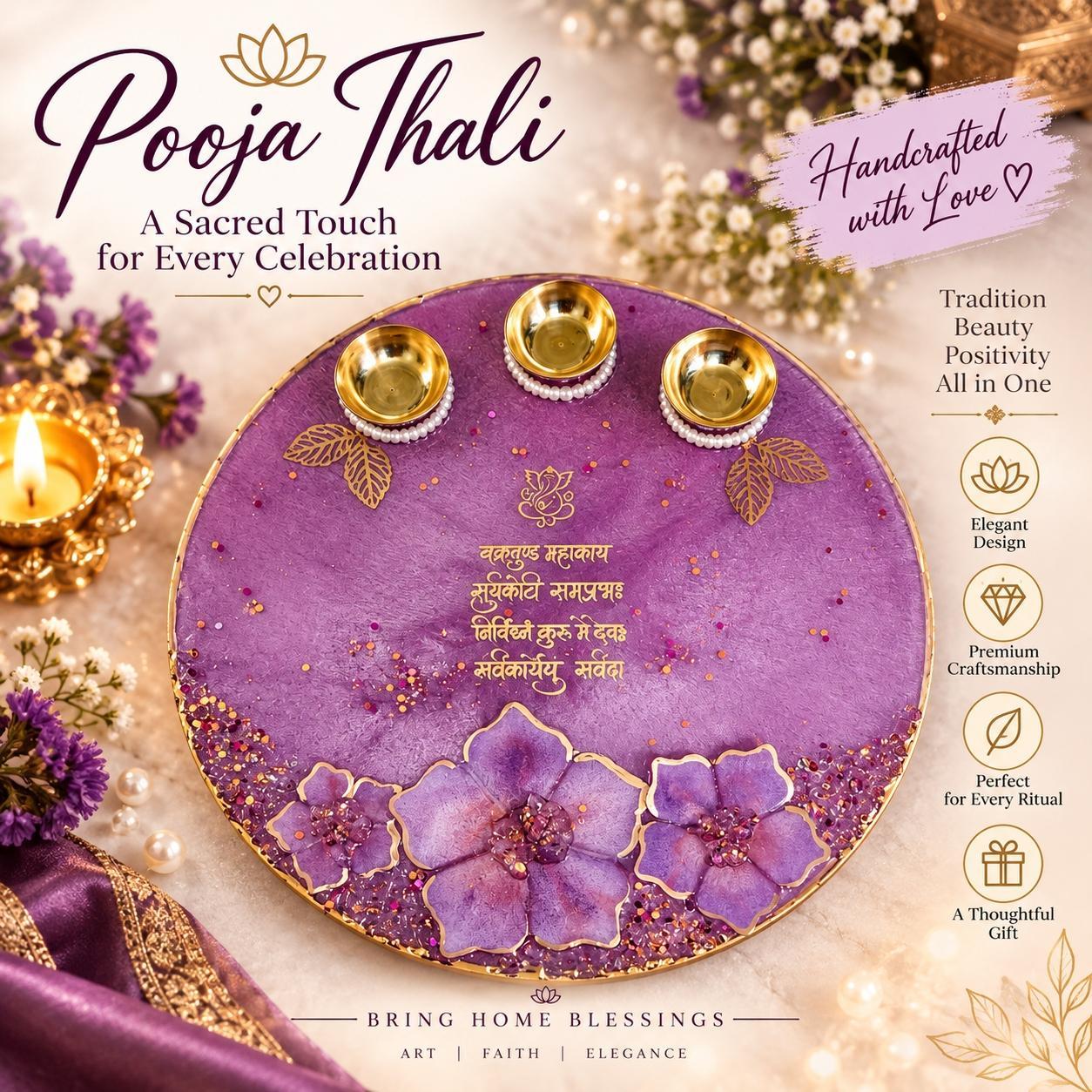
Sharad Navratri 2026 begins with Ghatasthapana on Sunday 11 October and runs nine nights to Navami on Monday 19 October, with Dussehra on Tuesday 20 October. In Ahmedabad that means garba every night, and before anyone leaves for the ground, aarti at home. The thali that comes out for those nine evenings gets more use in ten days than most household objects get in a year.
This article is about one specific piece we make for that: a scalloped resin pooja thali with five brass diyas, and everything you can change on it before we pour.
Why five diyas
Many Gujarati and North Indian families perform aarti with five lamps rather than one. You will hear it called panch aarti or panchdeep; the five flames are often linked to the five elements, though every family has its own reason and its own way of holding the thali. Whatever the reason in your home, the practical problem is the same. Five loose diyas slide around on a flat steel thali, oil spills, and by the third night someone is holding two of them in their other hand.
So our five-diya thali is built around the diyas rather than adding them at the end. Each brass diya sits in a pearl-bordered ring cast into the resin so it stays put while you circle the thali, and the peacock-charm hangers above them keep the layout balanced when all five are lit.
What is in the piece
- The thali itself: a scalloped-edge base cast in heat-resistant, non-yellowing epoxy resin, available in 10, 12 and 14 inch diameters. The 12 inch is the one most families choose for aarti; the 14 inch is a centrepiece for a mandal or a large joint family.
- Five brass diyas in pearl borders. Real brass, so they take ghee or oil and the wick as normal. The resin never touches the flame.
- Pressed florals and a gold Ganesh mantra under the glossy top layer, sealed in.
- Peacock charm diya hangers above the diya rings, which keep the layout balanced when all five are lit.
- A high-gloss washable surface. After aarti, a damp microfibre cloth is all it needs.
The sample photographed on the product page is rich pink. That is a starting point, not the only option.
What you can customise
Colour
Any colour we can mix. For Navratri, families often ask for the colour of the day their main puja falls on, or for the colour of the mata ni chundadi they use at home. Deep red and maroon are the most requested, followed by royal blue, emerald and a saffron-orange that photographs beautifully under diya light. Send a reference photo of a saree, a chaniya choli or the mandir backdrop and we will match the mood, though not an exact shade, because pigments in resin marble and shift a little in every pour.
Inscription
The standard piece carries a Ganesh mantra in gold. We can change that to the Gayatri Mantra, to "Shubh Labh", to "Jai Mata Di" or "Jai Ambe", or to your family name and the year. Text goes in as gold lettering under the top layer, so it will not wear off with handling. Short inscriptions read best; a name and a date is ideal, a full shloka in small type is not.
Number of diyas and layout
Five is the standard on this design. If your family uses a single large diya with four small ones, or you want two diyas and space for a dhoop stand, tell us. We reposition the rings before casting, not after.
Florals and motifs
Pressed flowers can be swapped for a mor pankh (peacock feather) motif, a lotus, or gold-leaf sprigs. We also embed a small dried flower from your own garden or a previous puja if you send it to us in advance.
Sizes and prices
- 10 inch: ₹1,199
- 12 inch: ₹1,499
- 14 inch: ₹1,700
Colour changes and a name or date inscription are included. A different mantra or a rearranged diya layout is usually included too; anything more involved is quoted before we start. If you want the same design for a mandal or as return gifts, the two-diya versions such as the Shubh Labh thali and the mint blossom thali start at ₹599 in the 6 inch size and go into bulk pricing.
Using it safely across nine nights
- Light the flame only in the brass diyas. Never place a lit diya or a mosquito coil directly on the resin surface.
- Trim wicks short. A tall flame is what marks the ceiling, not the thali.
- Wipe spilled ghee or oil the same night. It will not damage the resin but it dulls the shine if left for days.
- Rinse under running water if needed, but do not soak it, and keep it out of the dishwasher.
- Store it flat and away from the window between festivals. Long hours of direct sun are the only thing that ages resin.
Honest delivery dates for Navratri 2026
A customised thali takes 10 to 14 days in the studio. Ghatasthapana is 11 October. Here is what that means depending on where you are:
- Ahmedabad and Gandhinagar: order by the last week of September and it will be with you before the first night. Local delivery is a day or two.
- Surat, Vadodara, Rajkot and the rest of Gujarat: order in the same window; add two to four days of courier time.
- Rest of India: an order placed in the first days of October will most likely arrive during Navratri rather than before it. If it must be there for Ghatasthapana, message us first and we will tell you plainly whether it is possible.
- USA, Canada, Australia, UK: with 6 to 9 business days of air transit, a thali ordered now is a Diwali thali, not a Navratri one. Diwali is Sunday 8 November, which works out well. Our USA, Canada and Australia pages cover shipping and customs.
We would rather tell you that now than take an order we cannot land in time.
After Navratri
The same thali comes back out for Sharad Purnima, Karva Chauth, Dhanteras and Lakshmi Puja within the next four weeks, and then for every Tuesday and Thursday puja after that. That is really the argument for a made-to-order thali over a steel one: it is used constantly, and it is the piece that ends up in the photos.
To order, open the five-diya thali, pick your size, and add your colour and inscription in the note at checkout. Or send Heta a reference picture on WhatsApp and she will reply with what is possible and when. Browse the rest of the pooja thali collection if you want to compare layouts first.