Every resin piece that leaves the VEDUMI studio is, in a strange way, thousands of years old. Not the object itself — but the material, and humanity's relationship with it. Long before "resin art" was a phrase anyone used, resin was already one of the most quietly important substances in human history.
Where It Begins: Tree Resin and the Stone Age
Resin, in its original form, is a sticky organic substance that trees produce to seal wounds in their bark and protect themselves from insects and disease — pine sap, copal, frankincense, and amber are all natural tree resins. Archaeological evidence shows that Stone Age humans were already using tree resin, often mixed with charcoal, as an adhesive to fasten stone tools to wooden handles. It was, quite literally, one of our earliest engineering materials.
Amber: Resin as Treasure
Amber — fossilised tree resin, millions of years old — has been prized as jewellery and a decorative material since at least the Neolithic era. It was traded in vast networks across ancient Europe and the Mediterranean, valued for its warm glow and the way it could trap and preserve tiny fragments of the natural world inside itself: insects, seeds, even air bubbles from an ancient forest. In a sense, amber was the first "preservation resin" — a role resin still plays today, from museum conservation to a bride's preserved varmala.
Egypt, Greece, and the Practical Resin
Ancient civilisations found deeply practical uses for resin. The Egyptians used it in mummification and as a sealant; the Greeks and Romans used it to waterproof ships, seal wine vessels, and varnish wood and artefacts to protect them from the elements. Long before anyone thought of resin as an art material, it was valued for one thing above all: its ability to protect and preserve.
The Leap to Synthetic Resin
For thousands of years, "resin" meant natural resin. That changed in the early twentieth century. In 1907, the Belgian-American chemist Leo Baekeland invented Bakelite — the world's first fully synthetic plastic — proving that carefully controlled chemical reactions could produce entirely new materials with properties nature never offered. It opened the door to a new category of resin altogether.
The epoxy resin used in contemporary resin art has its own origin story. In the late 1930s, two chemists working independently — Dr. Pierre Castan in Switzerland and Dr. Sylvan Greenlee in the United States — both developed the chemistry behind what we now call epoxy resin. Castan, working on synthetic materials for dental prosthetics at a lab in Zurich, filed his epoxy resin patent in 1938 (granted in 1940). In 1943, the Swiss chemical company Ciba acquired his patents and, in 1946, launched Araldite — the world's first commercially successful epoxy adhesive. Around the same time, Greenlee was pursuing closely related chemistry at Devoe & Raynolds in the US, patenting his own developments through the 1940s.
What began as an industrial adhesive — used to bond metal, seal machinery, and coat surfaces — would eventually find its way into an artist's hands.
From Workshop Adhesive to Art Material
Through the 1950s and 60s, epoxy resin's glass-like clarity and durability caught the attention of artists, particularly within avant-garde and modernist movements exploring new industrial materials. Its glossy, almost liquid-looking finish became a hallmark of a new kind of art — one that didn't just depict light and colour, but seemed to hold them.
Resin art has grown steadily since, helped along by safer, more refined formulations that made the material accessible to studios (and eventually home hobbyists) far beyond industrial settings.
An Indian Parallel: Lac and Resin Craft
India has its own long relationship with resin-adjacent materials — most notably lac, a natural resin secreted by the lac insect, used for centuries in traditional Indian lacquerware, bangle-making, and decorative inlay work across states like Rajasthan and Gujarat. While lac and modern epoxy resin are chemically different, the underlying instinct is the same one VEDUMI works from today: taking a fluid, workable material and turning it into something permanent, decorative, and worth keeping.
Resin Today, at VEDUMI
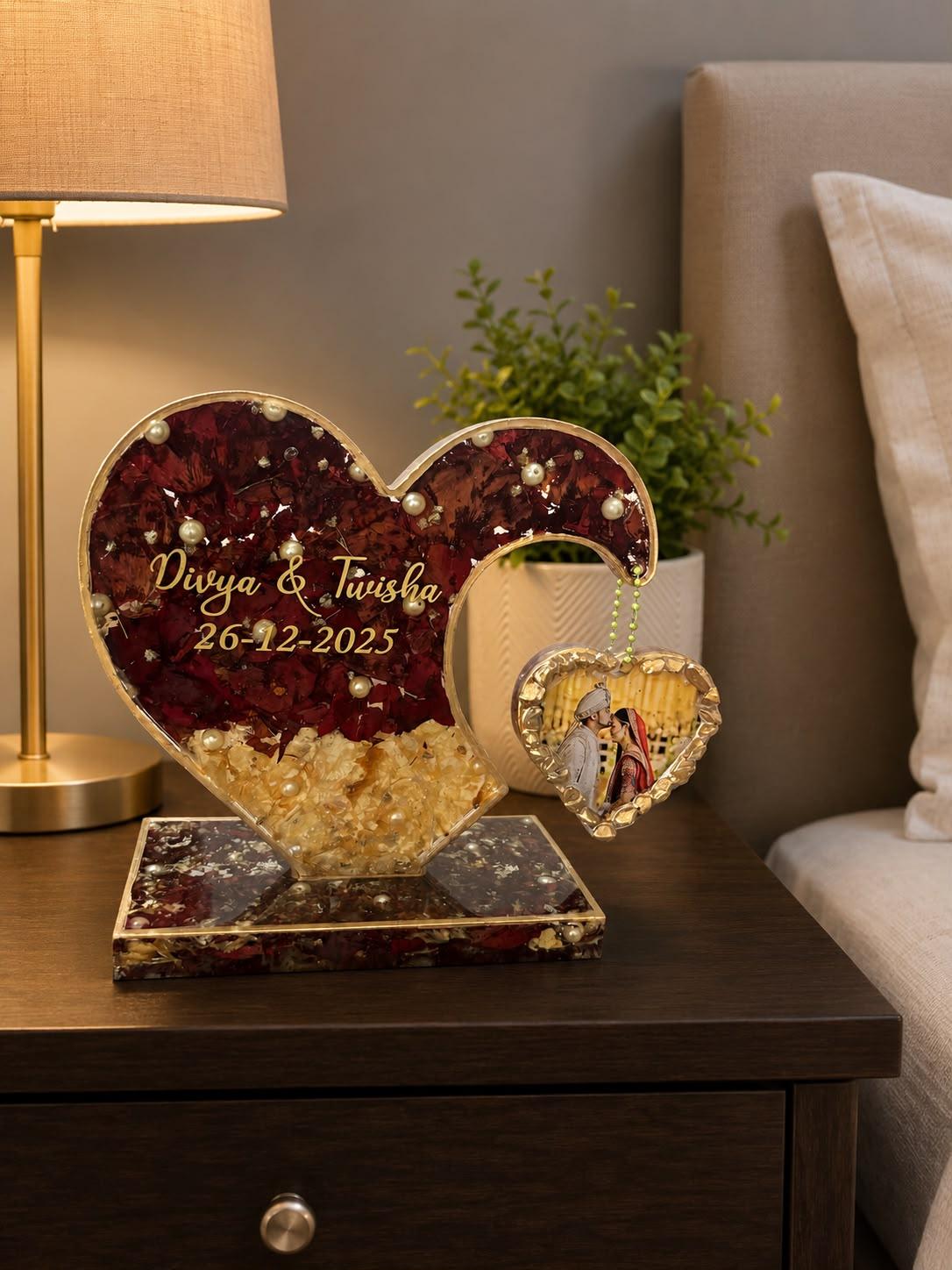
When Heta Patel pours resin in the VEDUMI studio in Ahmedabad — for a wall panel, a wedding varmala keepsake, or a corporate gift — she's working within a material tradition that stretches back to Stone Age tool-makers and Neolithic amber traders, through Swiss chemistry labs in the 1930s, into a contemporary Indian art studio today. Every cured piece is, in its own small way, a continuation of that story.